


Unlocking the carbon value chain
Project CAPTURED: Demonstrate the offloading, handling, utilisation and/or permanent storage of onboard captured CO2
Completed
Project overview
Timeline
Start 2Q 2025 • End 1Q 2026
GCMD team members
Eng Kiong KOH
Lead
Elaine SUN
Bruno PIGA
Lynn LOO
Victor PANG
Chen LI
Wee Meng TAN
Partners
Phase one project lead and OCCS provider:
• Shanghai Qiyao Environmental Technology Co., Ltd.
Vessel owners:
• Evergreen Marine Corp.
• Zhoushan Dejin Shipping Co., Ltd.
End-users:
• Baorong Environmental Co., Ltd.
• Greenore
Life cycle assessment advisor:
• DNV China Co., Ltd.

Link copied to clipboard
Objective
To demonstrate ship-to-ship (StS) liquefied CO2 (LCO2) offloading operation at Yangshan Deepwater Port, Shanghai, and the utilisation of onboard captured CO2 to recycle steel slag and produce post-carbonated slag (PCS) and precipitated calcium carbonate (PCC)
Project scope
• Conduct safety studies for transferring LCO2 and develop an emergency response plan
• Conduct ship compatibility assessment for LCO2 transfers
• Identify compliance pathways for offloading onboard captured CO2 from international vessels
• Conduct life cycle assessment (LCA) of greenhouse gas (GHG) emissions associated with onboard carbon capture and storage (OCCS) across the carbon value chain
Highlights
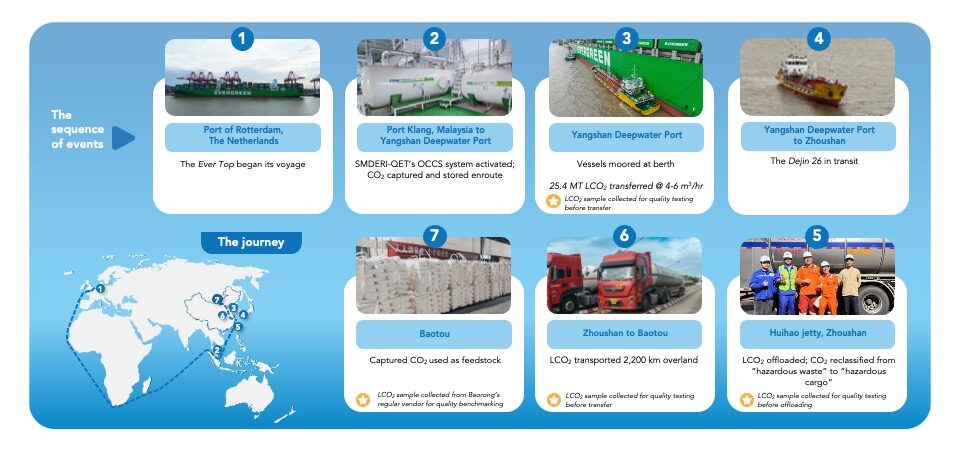
Part 1 – Technical, operational, and regulatory learnings from the first end-to-end demonstration of onboard captured CO2 utilisation
The pilot confirmed both the technical and operational feasibility of integrating maritime carbon capture into an industrial CO2 utilisation pathway, effectively linking shipping decarbonisation efforts with heavy industry’s demand for low-carbon feedstocks. Several key highlights include:
• Tracked quality and quantity of CO2: Comprehensive sampling and analysis were carried out to monitor the quality and transferred volumes of LCO2 across the value chain. Across all custody transfer points, CO2 purity exceeded 99.95 vol%, meeting the downstream user’s specifications.
• Safe and controlled operations ensured: Operations were conducted after rigorous hazard identification, mooring analysis and LCO2 leak assessment, with multi-zone access controls. Handling and transfer of LCO2 followed procedures adapted from existing liquefied natural gas and liquefied petroleum gas transfer protocols. No safety incidents occurred during the trial.
• Regulatory hurdles overcame: Early authority engagement allowed for the one-off, project-specific reclassification of captured CO2 from “hazardous waste” to “hazardous cargo”, enabling lawful land transport and industrial utilisation under Chinese regulations.
• Commercial viability demonstrated: The captured CO2 was successfully mineralised into PCC, a high-value functional filler used in products, such as paper, plastic, paint, and building materials, as well as PCS as sintering material for steel production or supplementary cementitious material (SCM).
Looking ahead, the learnings from the pilot highlight that scaling the carbon value chain will require:
• Adapting policies and regulations: Classifying high-purity captured CO2 as “hazardous cargo” will be essential to enable lawful land transport and industrial utilisation at scale.
• Improving commercial viability: Co-locating offloading and utilisation sites, expanding industrial partnerships, and promoting CO2-derived product markets can increase the commercial drive for carbon capture.
• Streamlining operations: Key steps include aligning tank capacities and transfer volumes as well as enhancing transfer equipment insulation to reduce CO2 vaporisation, installing custody transfer-grade flow meters and inline gas analysers to monitor CO2 quality, and standardising safety protocols, such as emergency shutdown interfaces and mooring configurations.
Part 2 – Quantifying the life cycle emissions of the onboard captured CO2 value chain: From ship-to-ship offloading and transport to utilisation
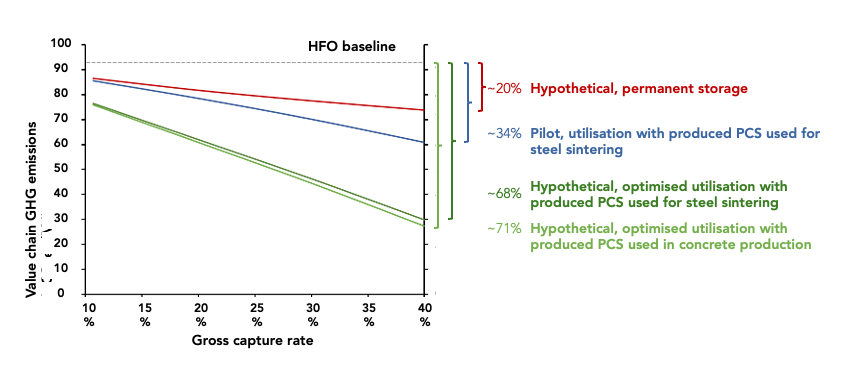
This part of the project involved a detailed LCA of the carbon value chain, demonstrated in the pilot. Building on this baseline, the study also examined two hypothetical scenarios, one in which the inefficiencies associated with the first-time pilot are addressed and another in which captured CO2 is permanently sequestered in an offshore reservoir.
In the utilisation scenarios, producing PCC with captured CO2 displaces conventional carbon-intensive production methods, while the use of PCS replaces standard sintering materials in steelmaking, resulting in a reduction of emissions that would have otherwise been released (“avoided emissions”). Several key highlights include:
• GHG emissions savings demonstrated: Project CAPTURED, with OCCS operating at a 10.7% capture rate, demonstrated 7.9% GHG emissions savings across the entire carbon value chain. This corresponds to 0.84 tonnes of CO2 savings realised per tonne of CO2 captured and offloaded from the vessel.
These savings were achieved despite several operational constraints, including the absence of a waste heat recovery system onboard that increased the fuel penalty, long-distance overland truck transport, as well as CO2 venting during offloading and handling.
When these inefficiencies are addressed, GHG emissions savings increase markedly to 17.8%, equivalent to approximately two tonnes of CO2 avoided per tonne of CO2 captured and offloaded from the vessel.
• CO2 utilisation can avoid more GHG emissions than permanent storage The study finds that the specific CO2 mineralisation pathway in this pilot outperforms permanent storage.
At comparable capture rates of 40%, mineralising CO2 yields 34% GHG emissions savings, compared with 21% if CO2 were sequestered in an offshore reservoir. When the value chain is optimised, this gap widens further, with the total GHG emissions savings rising to 68-71% depending on whether the PCS produced is used in steel sintering or in concrete production.
This comparison reveals that CO2 utilisation by carbon mineralisation can deliver greater overall climate benefits than permanent storage when captured CO2 is durably fixed over extended periods, defined under the EU ETS as 100 years or more, and as in the case of PCC that is used in construction.
Report: Project CAPTURED Report Part 1 – Technical, operational, and regulatory learnings from the first end-to-end demonstration of onboard captured CO2 utilisation
Report: Project CAPTURED Report Part 2 – Quantifying the life cycle emissions of the onboard captured CO2 value chain: From ship-to-ship offloading and transport to utilisation
Get in Touch

