

Enabling ammonia as a marine fuel
Phase 2: Vessel-, location-, and operations-specific safety assessments for a ship-to-ship ammonia transfer
Completed
Project overview
Timeline
Start 3Q 2023 • End 1Q 2026
GCMD team members
Vibin CHANDRABOSE
Lead
Chen LI
Kenneth TAN
Wei Jie LAU
Wee Meng TAN
Partners
bp Shipping
Chevron
DNV
Eastern Pacific Shipping
James Fisher Fendercare
Hong Lam Marine
IHI Corporation
Itochu
MISC
Mitsui & Co.
Navigator Gas
OSRL

Link copied to clipboard
Objective
To use ship-to-ship transfers as a proxy to understand ammonia bunkering
Project scope
• Conduct risk assessment studies for vessels
• Evaluate impact of spill through quantitative risk assessment (QRA) and computational fluid dynamics (CFD) studies
• Develop emergency response plans (ERP)
• Develop plans for trials
Highlights
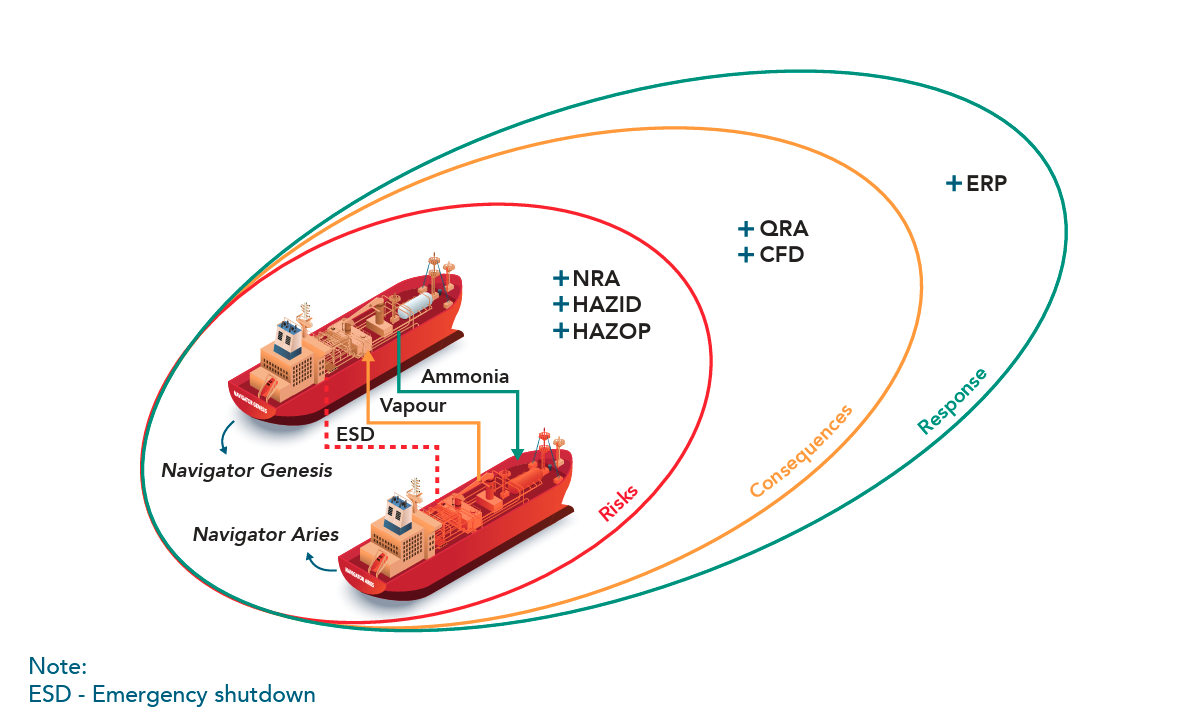
Conducted with industry partners, the safety assessments evaluated the feasibility of ammonia transfers between two handysize liquid ammonia carriers at Raffles Reserve Anchorage.
Key highlights from the safety studies include:
• Navigational risk assessment (NRA) confirmed that the transit and side-by-side mooring of two gas carriers can be safely managed under local weather and sea-state conditions, capped at a conservative abort criteria with significant wave height of 1.5 m-2.0 m and wind speeds of 23 knots (12 m/s), and continuous pilotage support for emergency separation and manoeuvring when needed.
• Hazard identification (HAZID) and hazard and operability study (HAZOP) workshops each identified 11 medium-level risks, primarily related to vessel interface, mooring integrity, equipment reliability, and procedural adherence. These risks were deemed tolerable with proper mitigation measures, including clearer emergency response planning and strict adherence to procedures and checklists.
• QRA demonstrated that safety zones can be established, with deterministic modelling recommending a conservative safety zone having a radius of 547 m for once-a-year transfers.
• CFD plume dispersion modelling revealed the formation of toxic clouds that could compromise escape routes and accommodation intakes in the most credible worst-case scenario of pipe rupture, resulting in a release of 12 m3 of ammonia on deck. These findings reinforce the importance of robust detection systems, rapid isolation measures and effective crew protection.
• ERP outlined a tiered response strategy and emphasised the need for strong shipboard readiness in the initial minutes of a release incident, supported by coordinated shore-based and agency resources for any progressive escalation.
Report: Vessel-, location- and operations-specific safety assessments for a ship-to-ship ammonia transfer in Singapore’s port waters
Get in Touch

